
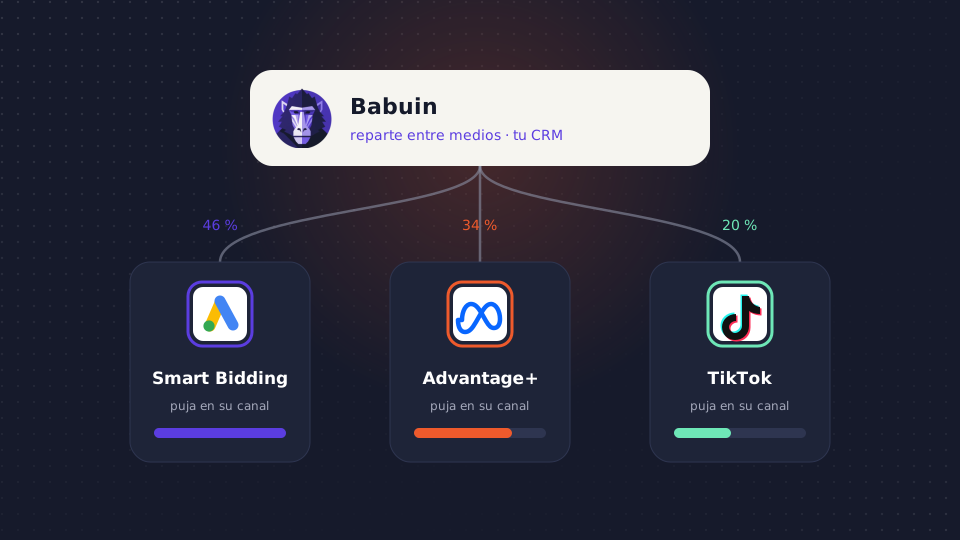
Almost every advertiser already uses Google Ads automated bidding and Meta’s Advantage+ campaigns. They work, and switching them off would be a mistake. But each one optimizes inside its own platform, with the conversions that platform sees. Nobody decides how much Google should get compared with Meta, or checks whether the conversions each one claims show up in your sales.
In this article we compare what each tool automates, what data it uses and where it falls short, so you can decide which combination you need.
In short
- Smart Bidding sets the bid in every Google Ads auction to get conversions or conversion value.
- Advantage+ automates the audience, placements, creatives and budget allocation within the campaign on Meta.
- Neither of them allocates the budget across platforms or measures against your CRM, unless you send them those sales.
- Babuin replaces neither: it allocates the budget across media with your business data and controls how it is spent within each campaign.
What Smart Bidding does in Google Ads
Smart Bidding is the set of Google Ads automated bid strategies based on machine learning: Maximize conversions, Maximize conversion value and their versions with a cost-per-action target (Target CPA) or a return-on-ad-spend target (Target ROAS). In every auction, Google adjusts the bid based on signals such as the user’s device, location, time of day or search history.
Performance Max brings the same logic to all of Google’s inventory in a single campaign: Search, YouTube, Display, Discover, Gmail and Maps.
Its limit is its scope: it optimizes spend on Google and learns from the conversions recorded in Google Ads. If those conversions are form fills, it will look for more form fills.
What Advantage+ does in Meta
Advantage+ is Meta’s family of automations. Advantage+ campaigns decide who to show the ads to, in which placements across Facebook, Instagram, Messenger and Audience Network, which creative variants to use and how to allocate the budget across ad sets.
As with Google, the scope is Meta, and learning depends on the events it receives through the pixel and the Conversions API.
What neither of them can see
- The other platforms. Google doesn’t know how your investment in Meta or TikTok is performing, and vice versa. Neither can decide the allocation across media.
- Your real sales. They only see what you send them. Without offline conversions, they optimize towards form fills, carts or installs, not towards customers.
- Double attribution. Each one claims the whole sale even if the customer went through both, so their figures add up to more sales than actually exist. We explain it in advertising attribution.
- Their own incentives. Both are designed to spend the budget you give them. Neither will tell you that the next euro would perform better on another channel.
Where Babuin fits
Babuin works above the platforms, not instead of them. Campaigns keep buying in Google’s and Meta’s auctions with their automated bidding. What it adds are two decision layers with your business data:
- DBA allocates the budget across media every day, based on each one’s cost per sale, lead or install as measured in your source of truth. If a network reports conversions your CRM doesn’t see, it takes budget away from it.
- MonkeyBot controls spend within each campaign. It doesn’t hand over the whole budget at once: it releases it in slots and checks the result of each slot before releasing the next.
Comparison
| Smart Bidding | Advantage+ | Babuin | |
|---|---|---|---|
| Where it acts | Google Ads | Meta | Above all your media |
| What it decides | The bid in each auction | Audience, placements, creatives and allocation within the campaign | The allocation across media and the pace of spend in each campaign |
| With what data | Conversions recorded in Google Ads | Events from the pixel and the Conversions API | Your source of truth: CRM, ERP, MMP or Excel |
| Sees other platforms | No | No | Yes |
| Replaces the others | — | — | No: it works with them |
When to use each combination
- A single channel and good conversions: that platform’s automation, fed with your sales as offline conversions, is usually enough. A cross-media layer adds nothing if there is no allocation to optimize.
- Two or more media and a reliable CRM, ERP or MMP: automated bidding inside each platform and Babuin on top, to decide the allocation with the same data across every channel.
- Few conversions: below about 50 conversions per month per medium, no algorithm has enough signal. First it is worth moving the goal up a level, for example from sale to qualified lead, or grouping campaigns.
The platforms will keep optimizing their metrics. The question is who optimizes yours.
Frequently asked questions
Does Babuin replace Smart Bidding or Advantage+?
No. Campaigns keep buying in Google’s and Meta’s auctions with their automated bidding. Babuin decides how much budget each medium gets with DBA and controls the pace of spend in each campaign with MonkeyBot, measured against your source of truth.
What is the difference between Smart Bidding and Advantage+?
Smart Bidding is Google Ads’ set of automated bid strategies: they adjust the bid in each auction to get conversions or value. Advantage+ is Meta’s set of automations: they decide the audience, placements, creatives and budget allocation within the campaign. Each one acts only on its own platform.
Can I use Performance Max and Advantage+ at the same time?
Yes, and it is common. The problem is that each one claims its own conversions and neither decides how much to invest in the other. That requires measuring both against the same reference, such as the sales in your CRM.
How do I improve the results of automated bidding?
By sending it better conversions: sales or qualified leads from the CRM, with their value, instead of form fills. We explain it in the offline conversions guide.