
Ask in a meeting how many sales last month’s campaign brought in and you will probably get three answers: Google Ads’, Meta’s and the CRM’s. All three can be defended and none of them match. Until someone decides which one rules, each team optimizes towards its own.
The source of truth settles that argument before it starts. In this article we explain what it is, how to choose it based on your type of business and how to use it so that bidding and budget allocation work with the same data.
In short
- The source of truth is the system where your business records the results that matter: the CRM, the ERP, your app’s MMP, Google Analytics, your e-commerce or a spreadsheet.
- It doesn’t replace each platform’s attribution: it becomes the reference they are all compared against.
- A good source records the real result, can be linked to the medium that originated it, arrives on time and is accepted by finance.
- It serves three purposes: sending results back to the platforms, comparing channels with the same yardstick and allocating the budget.
What a source of truth is
In marketing, the source of truth (often called the single source of truth, or SSOT) is the system that records the business results you decide to count, together with the rule that this data prevails over any other. It isn’t a new tool: you almost always have it already. It is the CRM where the sales team marks a lead as a customer, the ERP where an order is invoiced or the MMP that records the install and the purchase inside the app.
What changes is the role you give it. Instead of being the place where you look at the result at the end of the month, it becomes the reference used to measure and optimize every medium, every day.
Why each platform’s metrics aren’t enough
Google Ads, Meta and TikTok count conversions with their own attribution windows, include view-through and modeled conversions, and each one claims the whole sale even if the customer went through several of them. As a result, the platforms’ total almost always exceeds real sales. We explain it in detail in why each platform’s metrics don’t match your CRM.
On top of that, each platform only sees what happens on your website or in your app. It doesn’t know whether the lead was qualified, whether the order was returned or whether the sale closed over the phone. Your source of truth does.
Which source of truth to use for your business
There is no single answer. It depends on where the result you really care about happens:
If you have more than one, choose the one closest to the money. An insurance advertiser can measure forms in Google Analytics, but the signed policy is in the CRM. An online store sees the order in its e-commerce, but the return is recorded in the ERP.
Signs you don’t have one
- Each platform presents its own report and nobody knows which one to believe.
- The sum of Google, Meta and TikTok conversions exceeds real sales.
- The performance team celebrates a cost per lead that the sales team doesn’t recognize.
- The budget allocation across media is decided by gut feeling or by what each dashboard says.
- You can’t say, with a single number, how much it costs to win a customer in each channel.
Four conditions of a good source of truth
1. It records the real result
The closed sale, not the form; the delivered order, not the cart. The closer it is to revenue, the better it will guide the algorithms.
2. It can be linked to the medium that originated it
Each result must be traceable to a click, a campaign or, at least, a channel. For that, the CRM has to store the click ID or the UTM parameters that come with the lead, and the MMP, the install attribution.
3. It arrives on time
Data that is consolidated once a month works for the report, but not for optimizing. Bidding and budget allocation need results that are days old, not weeks.
4. Finance accepts it
If the CFO doesn’t trust that figure, it isn’t the source of truth. The goal is for marketing and the business to talk about the same number.
Define what counts as a result
Choosing the system isn’t enough: you have to decide which record counts. Is a lead valid when it comes in or when the sales team qualifies it? Does an order count on the day of purchase or when the return period ends? Do you measure the number of sales or their value? Write the definition down, apply it equally to every medium and don’t change it every month, or comparisons between periods will stop making sense.
How to use it to optimize campaigns
- Send the results back to the platforms. Sending your sales to Google Ads and Meta as offline conversions makes their automated bidding look for customers, not forms.
- Compare channels with the same yardstick. Calculate each medium’s cost per result with the data from your source of truth, not with each dashboard’s. It is the only way to make Google, Meta and TikTok comparable.
- Allocate the budget with that data. Shift investment towards the media that deliver the most results per euro according to your business, and review the allocation often, because each channel’s performance changes.
- Validate with attribution, MMM and incrementality tests. The source of truth tells you what was sold; models and tests help estimate how much of it is due to each medium and how much would have happened anyway.
Common mistakes
- Choosing the most convenient data. Measuring forms because that is what is already connected, when what matters is the sale.
- Losing the link to the medium. A CRM that doesn’t store the lead’s origin records sales, but can’t tell which channel brought them in.
- Having two truths. Marketing optimizes with one figure and the business evaluates with another. Sooner or later, the budget gets decided with the wrong one.
- Using it only for the report. If the data doesn’t go back to the platforms or into budget allocation, the campaigns keep optimizing towards what each platform counts.
How Babuin does it
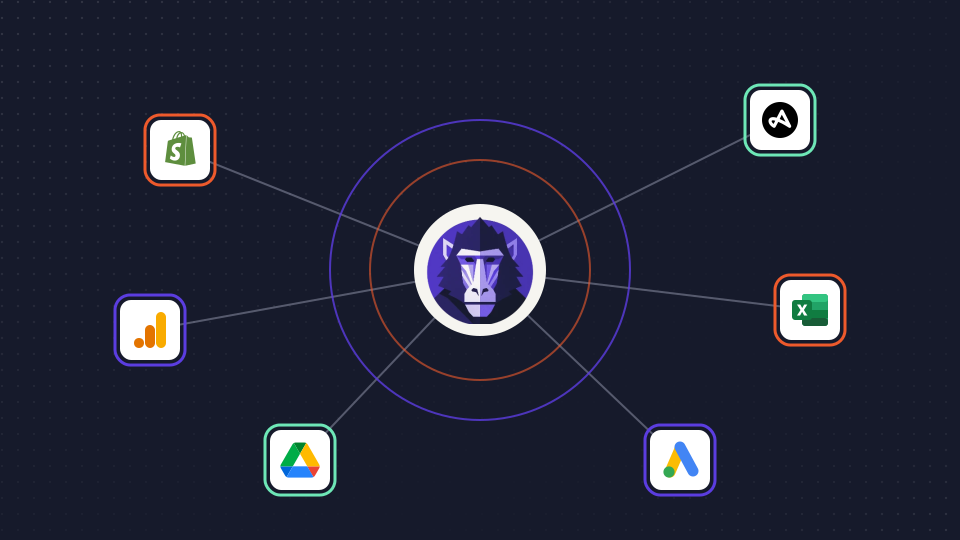
Babuin, the MonkeyFlux platform, connects to your source of truth, whether it is a CRM, an ERP, an MMP such as Adjust or AppsFlyer, Google Analytics, your e-commerce or a spreadsheet. With those results, MonkeyBot bids within each medium and DBA allocates the budget across channels every day based on each one’s cost per result. You can see every source that can be connected in integrations.
Platforms optimize their metrics. With a source of truth, your campaigns optimize yours.