
It is one of the most common conversations between a marketing director and their performance team. Meta’s report says one thing, Google’s another, the CRM a third, and the finance team only trusts the last one. Meanwhile, the campaigns keep being optimized with the first two.
In this article we look at why it happens, why it matters more than it seems and how to measure all your media against the same reference.
In short
- Each platform claims the whole sale even when the customer went through several of them.
- Attribution windows, view-through conversions, modeling and different dates make the figures non-comparable.
- Bidding algorithms learn from what the platform counts, not from what your business records.
- The solution is to choose a source of truth, send those results back to the media and compare every channel against it.
The symptom: the platforms add up to more sales than exist
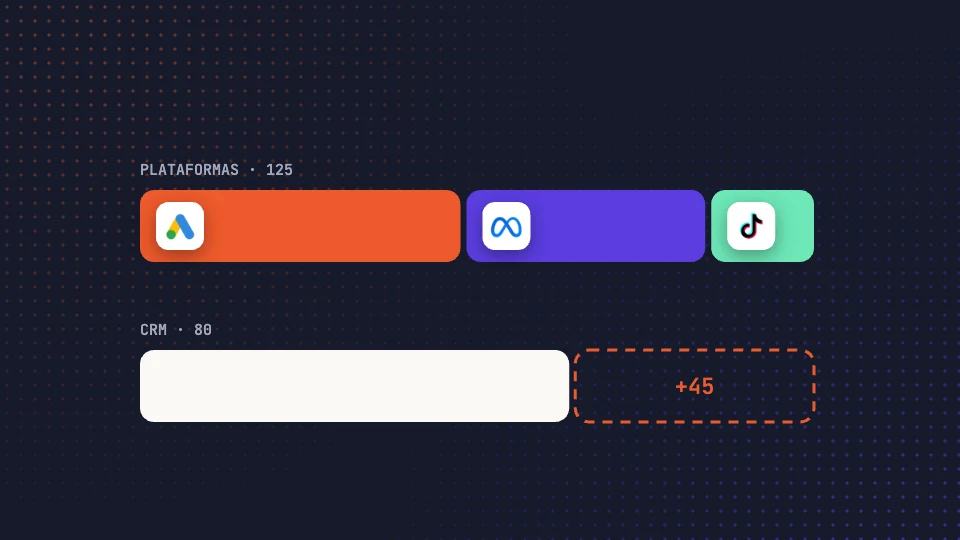
Imagine a month of campaigns across three media. Each platform reports its conversions and the CRM records the closed sales.
The problem isn’t only that the total doesn’t add up. You also don’t know what share of those 80 sales really belongs to each medium, which is exactly what you need in order to decide where to invest.
Six reasons the figures don’t match
1. Each platform claims the whole sale
A customer watches a video on TikTok, days later clicks on a Meta ad and finally searches for your brand on Google and buys. All three platforms took part and all three can count that sale as their own. None of them sees what happened on the others, so none can discount it.
2. Different attribution windows
The attribution window is the period during which a platform claims a conversion after the click or the impression. Each medium has its own defaults and each account can change them. Google Ads usually works with longer click windows than Meta or TikTok. Comparing the cost per conversion of two media with different windows is comparing different metrics.
3. View-through conversions
Some platforms count conversions from users who saw an ad but didn’t click. That impact may exist, but it is hard to prove and tends to inflate the results of video and display formats compared with search.
4. Modeled conversions
With cookie rejection, browser tracking restrictions and privacy changes on mobile, platforms can no longer observe every conversion. The missing ones are estimated with statistical models. It is a reasonable practice, but it means that part of what you see in the report hasn’t been measured: it has been calculated.
5. Different dates
Platforms usually assign the conversion to the day of the click or the impression. The CRM records it on the day the sale closes. In long sales cycles, such as insurance, a car or B2B software, a click in March can become a sale in May. Reports for the same month are counting different things.
6. What the platform can’t see
The pixel or tag records what happens on the website or in the app: a form, a cart, an install. They don’t know whether that lead was qualified, whether the order was returned or whether the sale closed over the phone or in store. The CRM and the ERP do know. That is why a medium can look the most profitable in its dashboard and be the one bringing in the worst customers.
Why it matters: algorithms optimize with what they receive
If the mismatch only affected the reports, a footnote would do. But the automated bidding of Google Ads, Meta and TikTok learns from the conversions each platform records. If what they count is forms, the algorithm will look for more forms, even if many of them never become customers.
The same goes for the budget. When the allocation across media is decided with each platform’s figures, the money tends to flow towards the channel that is best at claiming sales, which is not always the one that sells the most.
How to measure all your media against a single reference
There is no perfect attribution model, but there is a way to make every decision with the same data:
- Choose your source of truth. It is the system where your business records the results that matter: the CRM, the ERP, your app’s MMP, your e-commerce or even a spreadsheet. We explain it in integrations.
- Define what counts as a result. A closed sale, a qualified lead, an order that wasn’t returned or an install with activity. One single definition for every medium.
- Send those results back to the platforms. Uploading offline conversions lets Google Ads and Meta bidding learn from your real sales.
- Compare channels with the same yardstick. Calculate each medium’s cost per result with the data from your source of truth, not with each dashboard’s.
- Allocate the budget with that data. And review it often, because each channel’s performance changes from one week to the next.
How Babuin solves it
Babuin, the MonkeyFlux platform, automates these steps. It connects to your source of truth, sends the results to each medium so that MonkeyBot bids for real sales, and uses DBA to allocate the budget across channels every day based on what your business records. The reports show each medium’s cost per result measured against that same reference.
The platforms will keep claiming sales their own way. What matters is that your bidding and budget decisions don’t depend on it.