
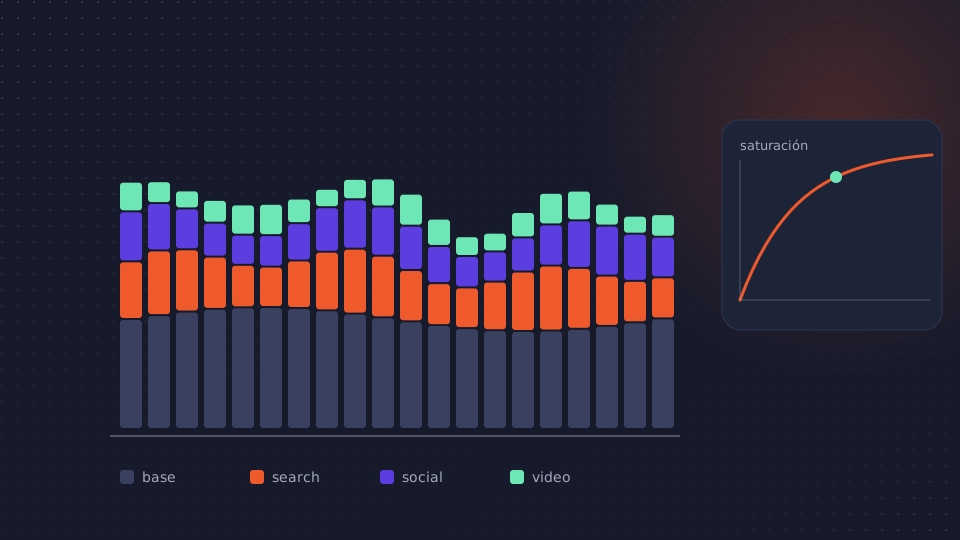
With cookie rejection and privacy changes in browsers and on mobile, click-based attribution sees an ever smaller part of the customer journey. And media such as TV, radio or out-of-home could never be measured with clicks.
Marketing mix modeling (MMM) is back in the spotlight because it doesn’t need to track anyone. We explain what it is, what data it needs and how it fits with attribution, incrementality tests and daily budget allocation.
In short
- An MMM relates weekly or daily spend in each medium to sales, discounting seasonality, price and other factors.
- It estimates each channel’s contribution and return, its saturation and what would happen with a different allocation. It isn’t meant for optimizing campaigns or creatives day to day.
- It needs a long history, spend by channel and the sales from your source of truth.
- It works best calibrated with incrementality tests and combined with a system that makes decisions every day.
What marketing mix modeling is
A marketing mix model is a regression: it explains a business variable, usually sales, based on spend in each medium and on other factors that also move it. It works with data aggregated by week or by day, not with users or clicks, so it can include offline media and doesn’t depend on cookies.
For the result to make sense, it builds in three ideas about how advertising works.
Adstock or carryover effect
An ad doesn’t only sell in the week it runs: part of its effect shows up later and gradually fades. Adstock captures that carryover, which is usually longer for TV than for search.
Saturation
Doubling spend doesn’t double sales. Beyond a certain level, each additional euro contributes less, and the model estimates that curve for each channel.
Baseline and external factors
Some sales would happen without advertising: repeat customers, brand, organic traffic. That is the baseline. Sales are also driven by seasonality, price, promotions or competitors. If the model doesn’t include them as control variables, it will credit the media with what was a calendar effect.
What an MMM answers and what it doesn’t
A well-built MMM answers budget questions:
- Each channel’s contribution. How many incremental sales each medium brings in.
- Return by channel. How much each euro invested sells, on average and at the margin.
- Saturation curves. How far it pays to increase spend in a channel.
- Scenarios. What would happen if you moved budget from one medium to another or cut the total.
What it doesn’t do is go into detail. With aggregated data it can’t tell which campaign or which creative works better, and it doesn’t react to what happened yesterday: it is updated every few weeks or months.
What data it needs
- Enough history. The usual minimum is two years of weekly data, so the model sees each season several times. With daily or regional data less may be enough, but there is no magic number.
- Spend by channel. Spend, and if possible impressions or GRPs, for each medium in each period. If a channel has always had the same spend, the model can’t measure what happens when it changes.
- Sales from your source of truth. The result your business trusts, from the ERP or the CRM, not each platform’s conversions. We cover it in what a source of truth is.
- Control variables. Price, promotions, seasonality, holidays, competitors and any event that has moved sales.
MMM, attribution and incrementality tests
They are three ways of measuring that don’t compete: each one covers what the others can’t see.
Multi-touch attribution follows each user’s journey and assigns credit to the touchpoints. It is fast and reaches campaign and ad level, but it only sees what can be tracked and tends to reward channels close to the conversion, such as branded search.
MMM looks at the whole picture, includes offline media and doesn’t depend on tracking. In return, it is slow, not very granular and depends on its assumptions: two reasonable MMMs with the same data can produce different allocations.
Incrementality tests are experiments. In a geographic test (geo-lift), spend is switched on or changed in some areas and compared with similar areas that act as a control. In a conversion lift study, the platform itself holds out a group of users who don’t see the ads. It is the closest thing to a causal measurement, but each test answers a single question, about one channel and one period.
Why calibrate the MMM with experiments
An MMM can mistake correlation for cause: if you always spend more in the weeks when you sell the most, it will credit the medium with what was demand. An incrementality test tells it what range of effect is realistic for that channel. Current tools let you feed it into the model, and it is one of the best ways to gain confidence in its conclusions.
Open-source tools
The two best-known options are published by the platforms themselves:
- Meridian, from Google. A Bayesian framework in Python that supports regional data and lets you incorporate experiment results as prior information. It replaces LightweightMMM, its earlier project.
- Robyn, from Meta. Originally developed in R, it automates the search for adstock and saturation parameters, generates several candidate models and also allows calibration with incrementality tests.
Free doesn’t mean simple: preparing the data, choosing the controls, checking that the results make business sense and keeping the model up to date takes time and statistical judgment.
Common mistakes
- Modeling the platforms’ conversions. If sales are already inflated by double attribution, the model inherits the problem.
- Forgetting external factors. Without price, promotions or seasonality, the model credits the media with what isn’t theirs.
- Taking the results as exact. An MMM gives estimates with a margin of uncertainty, and two similar returns may not actually be different.
- Never validating it. Without an experiment, you don’t know whether the model is right or just fits the past.
- Building it once and shelving it. A model from a year ago describes a market that no longer exists.
How to combine MMM with daily budget allocation
MMM sets the course: how much weight each channel should have and where it saturates. But weeks go by between one update and the next, and each medium’s performance changes.
That is why it makes sense to work on two levels. In the long term, MMM and incrementality tests validate the allocation across channels. Every day, a dynamic budget allocation system shifts spend based on each medium’s cost per result, measured with the same source of truth. If the two point in very different directions for weeks, it is time to review one of them or design a test to settle it. The condition is that both measure the same thing: if the MMM explains ERP sales and bidding optimizes each platform’s conversions, each level will defend a different figure.
How Babuin does it
Babuin, the MonkeyFlux platform, works at the daily level. It connects to your source of truth and, with those results, MonkeyBot bids within each medium and DBA allocates the budget across channels every day. Those decisions are validated with attribution, MMM and incrementality tests, so what is decided every day and what is measured in the long term start from the same data.
A good MMM tells you where to go. What happens between one update and the next counts too.
Frequently asked questions
What is marketing mix modeling?
It is a statistical model that estimates how much each medium contributes to sales from aggregated weekly or daily spend and sales data. It takes into account advertising’s carryover effect, each channel’s saturation and external factors such as seasonality or price, and it doesn’t need cookies or user tracking.
What is the difference between MMM and attribution?
Attribution follows each user’s journey and splits the credit among the ads they saw or clicked, with campaign-level detail and quickly, but it only sees what can be tracked. MMM works with aggregated data, includes offline media and estimates each channel’s contribution, but it doesn’t go down to campaign or creative level. The usual approach is to use both. We explain it in advertising attribution.
What is an incrementality test?
It is an experiment that measures how many sales a medium really generates by comparing a group exposed to the ads with one that isn’t. It can be run by geographic area (geo-lift) or with the platform’s own conversion lift studies. Its results are used to calibrate an MMM.
How much data does an MMM need?
The usual minimum is two years of weekly data on spend by channel, sales and control variables such as price, promotions and seasonality. With daily or regional data you can work with a shorter period. In addition, spend in each channel must have varied enough for the model to measure its effect.